
What helps with varicose veins?
Varicose veins affect the legs and lower limbs — they are twisted and enlarged veins. They are usually caused by genetic predisposition, but there are also factors that can trigger them. Although varicose veins are not life-threatening, they can cause unpleasant symptoms. Fortunately, today there are many options that help relieve the symptoms of varicose veins and improve the patient’s quality of life.
Article guide:
- What are varicose veins?
- What are their symptoms?
- How does CBD work for varicose veins?
- What else can be used?
Article summary:
- The article explains what helps with varicose veins, what the most common causes of their development are, and how problems with the venous system manifest.
- It describes the importance of prevention, regular movement, compression aids, a healthy lifestyle, and options for supporting blood vessels with natural substances, including hemp products.
- The article also includes recommendations on when it is advisable to seek professional examination, especially in the case of pain, swelling, or worsening varicose veins.
What are varicose veins?
Varicose veins are a circulatory condition that affects the veins, especially in the legs and lower limbs. Normally functioning veins ensure the return of blood from the body back to the heart thanks to muscle contractions and valves that allow blood to flow only toward the heart.
Varicose veins are caused by problems with blood circulation in the legs. Veins work against gravity and are assisted by a system of valves, the connection between the deep and superficial venous systems, and the compression of surrounding muscles. When this system does not work — most often due to weakening of the vein wall — blood pools in the vein and enlarges it. The accumulated blood and increased pressure on the vessel walls lead to their enlargement and twisting.
Enlarged, twisted, and improperly functioning veins develop as a result of weakened vein walls and the inability of the valves to effectively prevent blood from flowing backward. As a result, blood remains in the veins, causing them to enlarge, change colour, and become deformed.
Varicose veins can cause unpleasant symptoms such as pain, swelling, itching, fatigue, cramps, and a feeling of heavy legs. Sometimes they may lead to more serious complications — inflammation of the veins, known as thrombophlebitis, or the formation of venous ulcers. It is therefore important to monitor and treat this condition.
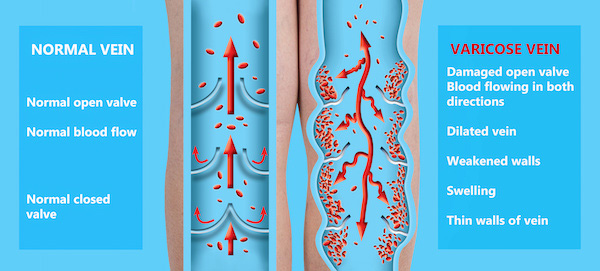
The image shows healthy blood circulation on the left and blood circulation affected by varicose veins on the right.
Symptoms of varicose veins
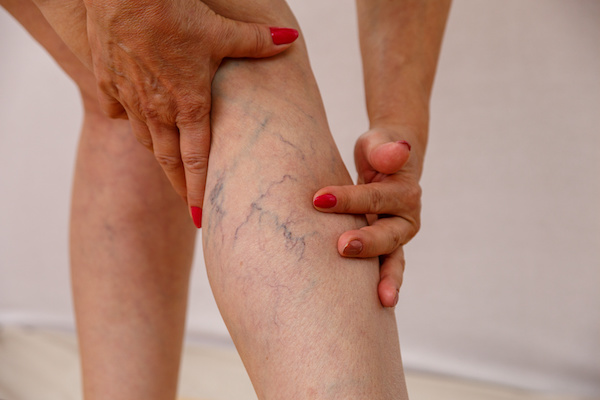
- Visibly enlarged and twisted veins: most often blue or purple veins visible beneath the surface of the skin, sometimes protruding above it.
- Pain or discomfort in the area of the affected veins.
- Swelling of the legs and ankles.
- Tiredness and heaviness in the legs.
- Cramps and muscle tension.
Factors that increase the risk of varicose veins
Varicose veins can affect people of different ages and genders, but women are affected most often — particularly during pregnancy and hormonal changes. Risk groups also include people with a family history of varicose veins, those whose occupation requires prolonged standing or sedentary work, and people who are overweight.
Varicose veins during pregnancy
During pregnancy, hormonal changes and the weight of the growing baby increase susceptibility to varicose veins. This is caused by:
- Higher progesterone levels, which relax blood vessel walls and reduce valve function.
- A greater blood volume in the body.
- The baby’s pressure on blood vessels in the pelvis, which changes blood flow in the pelvis and legs.
All these forces make it harder for blood to travel against gravity from the legs to the heart. In addition to varicose veins, constipation is also common during pregnancy and may cause haemorrhoids.
How are varicose veins treated during pregnancy?
Because varicose veins are usually harmless and improve after childbirth, healthcare professionals usually do not treat them directly — they only relieve symptoms and prevent them from getting worse.
You can help yourself by avoiding prolonged standing or sitting, exercising regularly, limiting sodium in your diet, and elevating your legs regularly. Did you know that sleeping on your left side can also help? This reduces pressure on the inferior vena cava, the large vein that carries blood from the legs to the heart.
Do varicose veins disappear after pregnancy?
Yes, they are usually temporary and shrink after the baby is born. If you have more children, they may worsen with each subsequent pregnancy. If they do not disappear after childbirth, contact your doctor and discuss suitable treatment options.
How can I prevent varicose veins?
The development of varicose veins can be prevented through regular physical activity, weight control, elevating the legs especially when working in a sedentary job, a balanced diet rich in vitamin C and flavonoids, and suitable footwear. If you suspect varicose veins, visit a doctor so that treatment can be started in time.
What are the treatment options for varicose veins?
Treatment for varicose veins may include home care measures, compression stockings, surgery, or other procedures. Procedures are often performed on an outpatient basis — you usually go home the same day.
Varicose veins — home treatment
Home treatment includes, for example, exercise, elevating the legs while sitting, and wearing compression stockings — all of which may reduce pain and prevent the condition from worsening.
In addition to a healthy lifestyle, you can also use the power of natural substances. Among herbs, well-established options include gotu kola (Centella asiatica), which, according to a review of clinical studies, supports blood flow and eases symptoms of chronic venous insufficiency, or grape seed extract (Vitis vinifera). The 2025 VICTORY randomized controlled trial showed that grape seed extract significantly reduced venous reflux time in both superficial and deep veins after 12 weeks and improved symptoms in patients with varicose veins — so far, this is the strongest objective evidence for a natural substance in this area.
Compression stockings
Wearing compression stockings throughout the day is usually the first recommended option. The stockings compress the legs and help the veins and leg muscles move blood more efficiently. Compression stockings are available in most pharmacies. Prescription stockings covered by insurance may also be available.
Ointment for varicose veins
Suitable ointments and gels help relieve pain, swelling, cramps, and muscle tension.
Professional treatment
In addition to home care, it is sometimes necessary to see a doctor. The 2025 SCAI clinical guidelines recommend compression therapy as the first choice, followed by these modern procedures:
- Sclerotherapy: Injection of a solution or foam into the vein, which scars and closes it. It does not require anaesthesia and can be performed on an outpatient basis.
- Laser treatment: Strong bursts of light cause the vein to gradually fade and disappear. No cuts or needles are needed.
- Radiofrequency ablation: A modern method in which heat generated by radiofrequency waves closes the affected vein. It is a minimally invasive outpatient procedure.
- Cyanoacrylate embolization: Closure of the vein using a special medical adhesive. It does not require tumescent anaesthesia or compression stockings after the procedure.
How does CBD work for varicose veins?
CBD cannot cure varicose veins or structurally repair damaged venous valves. So far, there are no high-quality clinical studies proving a direct therapeutic effect of CBD on varicose veins. However, thanks to its properties, CBD may relieve unpleasant symptoms associated with varicose veins:
- Anti-inflammatory effects: CBD has well-documented anti-inflammatory properties that may help reduce inflammation linked to varicose veins and their symptoms.
- Muscle relaxation: CBD may have relaxing effects on muscles and blood vessels, which could ease the feeling of heaviness and tiredness in the legs.
- Pain relief: CBD may help reduce pain associated with varicose veins and improve overall comfort.
How to use CBD for varicose veins?
We recommend combining internal and external use of CBD.
For internal use, take CBD oil twice a day — depending on the severity of the problem and your body weight, we recommend either 10% CBD oil or 20% CBD oil.
In addition to internal use, it is advisable to support the anti-inflammatory effect with suitable hemp topical care — we recommend CBD ointment or CBD cooling gel.
How does hemp ointment work for varicose veins?
Hemp ointment contains cannabinoids that act on the endocannabinoid system in the body, which may influence the perception of pain and inflammation. In varicose veins, it may help reduce pain, swelling, and inflammation associated with the condition. It has no direct effect on weakened vein walls or on the underlying cause of the disease — it provides symptomatic relief.
How does vitamin C work for varicose veins?
Vitamin C is one of the best-supported natural substances for promoting vein health, for several reasons:
- Support for collagen and elastin: Vitamin C is essential for the formation of collagen and elastin — proteins that make up the structure of blood vessels and connective tissue. Adequate vitamin C intake helps keep blood vessels strong and elastic, which may slow the development and worsening of varicose veins.
- Antioxidant protection: Vitamin C is a powerful antioxidant. It protects vein walls from damage caused by oxidative stress, which has been shown to contribute to the development of venous insufficiency.
- Support for vascular health: Vitamin C improves the bioavailability of nitric oxide, a molecule that helps relax blood vessels and improve blood flow — thereby reducing the risk of blood pooling in the lower limbs.
What complications are associated with untreated varicose veins?
Untreated varicose veins can lead to various complications, especially in advanced or neglected cases:
- Venous ulcers: Painful wounds near the affected veins that are difficult to heal, prone to infection, and require long-term treatment.
- Thrombophlebitis: Inflammation of the veins accompanied by the formation of a blood clot. If the clot breaks loose and enters the deep veins, deep vein thrombosis (DVT) may occur — a serious condition.
- Inflammation of the vein wall: Causes pain, swelling, and thickening of the skin.
- Hyperpigmentation: Increased blood pressure in the veins can cause darker spots or skin discoloration.
- Lipodermatosclerosis: The skin becomes hard, thickened, and discoloured around the varicose veins.
- Cellulite: Untreated varicose veins may worsen the appearance of the skin and contribute to the development of cellulite.
- Pain and reduced quality of life: Swelling, itching, a feeling of heaviness, and pain in the legs.
Article author: Lucie Garabas